ABOUT THE PROGRAM with Julia Bullock, 2026 Festival Director & Matthew Swanson, Director of Choruses
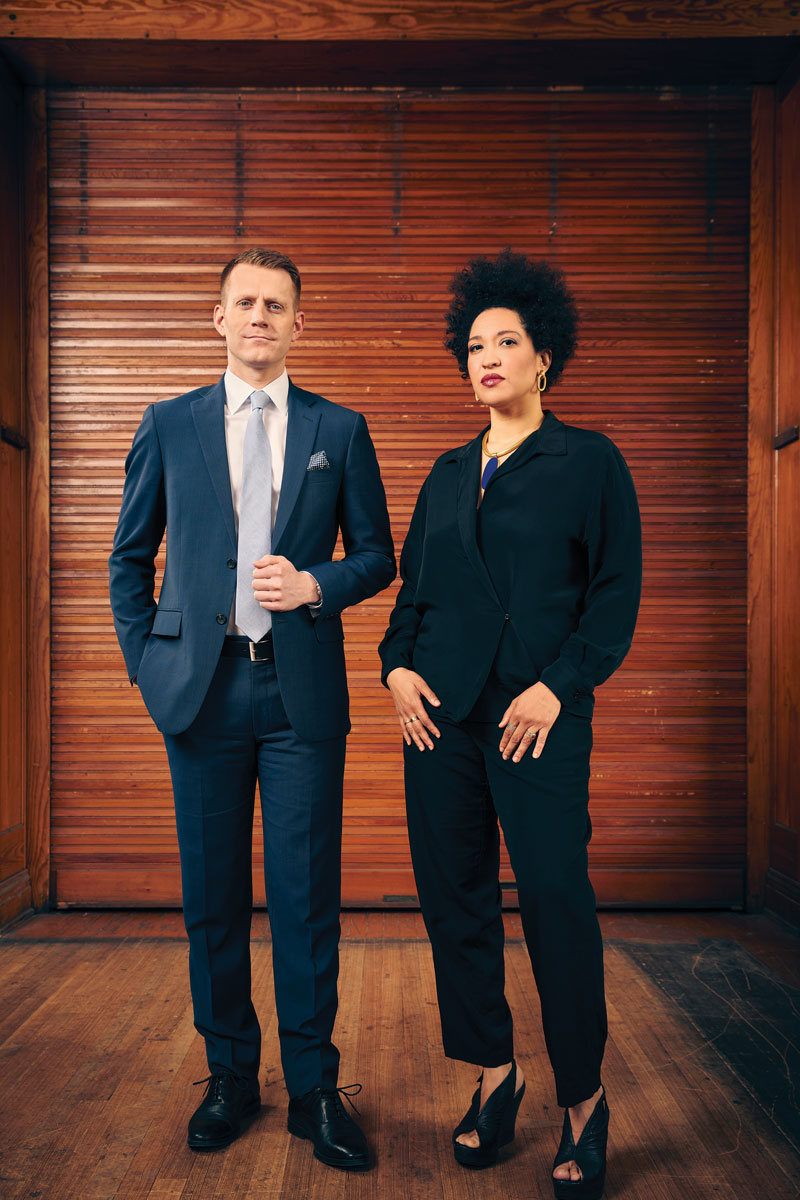
“Just thinking of it in my memory gives me goosebumps,” 2026 Festival Director Julia Bullock muses as she remembers the first time she heard Igor Stravinsky’s Les noces.
She was in a small Siberian town in Russia listening to a relatively small choral ensemble. What astounded Bullock was the singing. “It was not about how ‘pretty’ it sounded, or ‘how perfectly in balance’ the vocalism was. It was just about tossing out human utterances and uproar in their almost primal form. There are only a few pieces in the world that struck me in that way at first listen.”
Director of Choruses Matthew Swanson had a slightly different entry point to Les noces. The work had been performed at the University of Cincinnati College-Conservatory of Music the year before he enrolled there. “It was still in the air, people were still talking about it,” recalls Swanson. So, he got the score and studied it, and he found Les noces to be the “most intriguing and fascinating piece of art that I have ever come across.”
What makes Les noces so intriguing? Swanson found that “Stravinsky was saying more than he could encapsulate in one point of view. Les noces has more viewpoints, more messages and more identities as a piece than can be summed up by one single idea. The work does so many things at one time. There is a juxtaposition between sounds that are struck and words that are sung, between two surfaces colliding and air moving. There is an elemental and fundamental opposition concerning this dynamic.” Stravinsky himself seemed to understand this conflict, as he “stripped out all the other instruments that he could have considered for the piece, leaving only the cleanest possible division between these two opposing forces. Then comes 23 minutes of finding ways to constantly join them in seemingly endless combinations. It is amazing to me.”
And this is just the music. The text to Les noces depicts a wedding. While there are obvious differences between a 19th-century Russian wedding and a modern American wedding, there are more similarities than one might think. “The piece starts with the bride, her bridesmaids and her mother, getting her hair done and talking about getting her hair done,” states Swanson. The piece ends with The Wedding Feast in an “absolute cacophony of sound.”
Carl Orff’s Catulli Carmina is “the perfect pairing to Les noces,” affirms Bullock. “It has that operatic-scale energy, sweeping melodies for which Orff is famous and a text unlike anything else in the repertoire. It is very bold.”
The text is from the poet Gaius Valerius Catullus, who lived in ancient Rome from 84–54 B.C. Orff set the texts as a scenic cantata or, to use Swanson’s words, “a play within a play.” Although the texts are from an age very distant from our own, he notes, “they remind us that human beings have not changed that much at all.” In the Catullus texts, there are scenes of heartbreak, lust, love, hatred and infidelity written in a way that reflects the real lived experiences of Catullus and his peers.
“We, as an audience in the year 2026, get to talk to Catullus through Carl Orff,” explains Swanson. “I find it somehow reassuring that great artists of our civilization have been talking about the same topics and ideas that we do, today. So, to bring that art to life and give voice and body to it is quite thrilling to me.”