ABOUT THE PROGRAM with Julia Bullock, 2026 Festival Director & Matthew Swanson, Director of Choruses
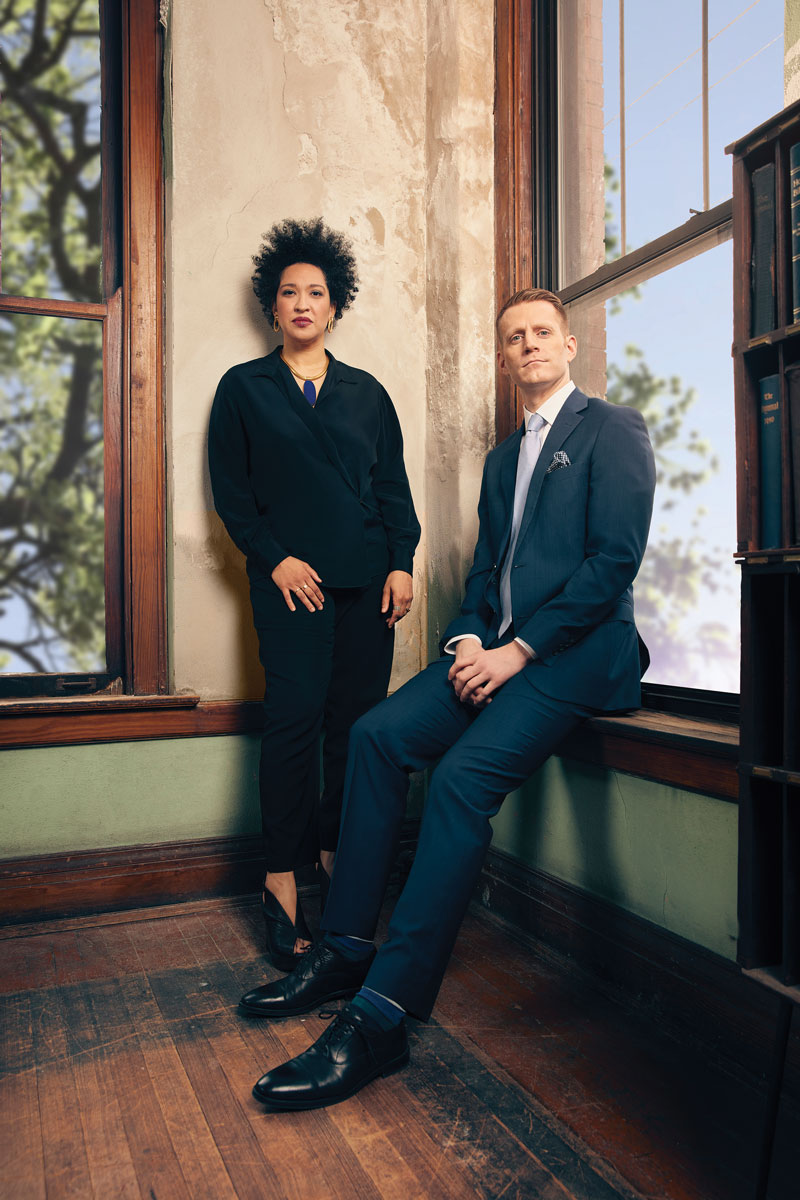
When Julia Bullock accepted the invitation to be the 2026 Festival Director, she asked for as many resources as the May Festival could give her: books, concert history, repertoire history, artists who had sung at the Festival, information about the city, etc. Bullock wanted to understand the May Festival, its history and its people.
Within these pages was the May 11, 1956, performance of selections from the Gershwins’ Porgy and Bess, sung by soprano Leontyne Price and baritone William Warfield. “This was the first time Black/African American soloists took to the stage at the May Festival,” recounts Bullock. “In 2026, the 70th anniversary of this historic moment, I thought we should bring Porgy and Bess back to the stage, but in a slightly different way.”
Bullock has curated selections from the opera for this year’s May Festival. The selections include iconic arias like “Summertime,” “I Got Plenty o’ Nuttin’” and “It Ain’t Necessarily So,” as well as the choral sections that allow the full May Festival family of choruses to gather together and share in extended community moments.
“One of the questions we wanted to consider for this Festival,” describes Bullock, “is how we want to address the current realities of the United States of America, which struggles so much to acknowledge its own history. We learn about our history, but because the culture and the geographical area of America are so wide-ranging, each one of us can be oblivious to a part of America’s history. This gap in our knowledge base (and stories) can lead to dismissals of each other’s humanity and become a barrier. Does this prevent us from acknowledging other human beings, and honoring the diversity of our experiences? Even if they are shared?”
In many ways, the May Festival is uniquely positioned to offer expressions of human experience. Choral singing is at the heart of the Festival. “All of these individual voices come together to express with one unified thought and intention,” reflects Bullock. “It’s a shared state of consciousness, where we are held responsible to and for each other — it is a profound act.”
The work of the Festival Director and Director of Choruses, then, is to create a unified and thoughtful connection between that profound act of choral singing and the creations of individual composers.
William Grant Still’s Plain-Chant for America is one such piece. “It is a piece with words by Katherine Garrison Chapin that hit you immediately,” states Bullock. “You will hear it one time, you’ll never forget it, and you’ll want to return to hear it again and again.” Director of Choruses Matthew Swanson adds, “It is both a historical artifact and a very present commentary. Ultimately, the piece is quite hopeful and quite optimistic, and it speaks of possibility.”