Connecting with the Next Generation of Singers
by David Lyman
For most of us, “May Festival” is a name that conjures up images of balmy spring evenings, choral extravaganzas and a Music Hall packed with oh-so-elegant audience members. These aren’t run-of-the-mill performances, mind you. On the contrary, each one is a musical gem, the sort of thing that befits a tradition-rich Festival that dates back more than 150 years.
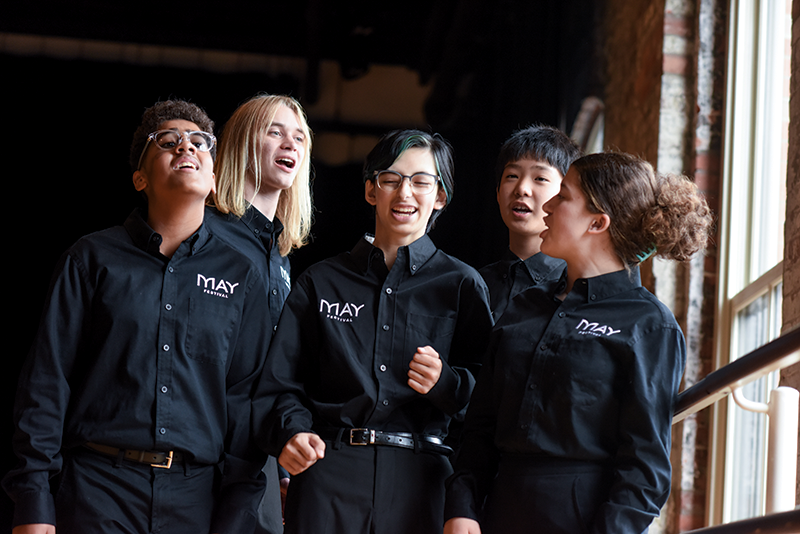
Those are glorious, even romantic images. But in reality, the May Festival umbrella stretches far beyond that handful of performances we see each spring.
Often overlooked in the grandeur of those spring performances are the May Festival’s youth programs. They may not have the high profile of the Festival performances, but the youth programs are every bit as important to the May Festival’s future.
“The May Festival has been educating since the very beginning in 1873,” says Edy Dreith, the Festival’s Education Manager. “That first year, [Charles] Aiken had a 500- or 600-member youth chorus on the stage,” she says, referring to the Cincinnati Public Schools’ Superintendent of Music whose bust is displayed in the second-floor lobby of Music Hall.
In the Festival’s early days, the involvement of young singers was an outgrowth of a remarkably robust music program in the public schools.
“It’s a different world today,” says Dreith. “Today, music education is becoming more exclusive. The music programs you and I may have enjoyed as fifth graders just aren’t there anymore.”
The import of that hasn’t been lost on the May Festival’s leaders. If kids aren’t learning an appreciation for music when they’re young, where will future audiences come from? And what does that mean for the future of the May Festival?

“The bottom line is ‘what do we need to do to survive,’” says Jason Alexander Holmes, Associate Director of Choruses and May Festival Youth Chorus Director. “The answer is clear. We need to engage with our communities.”
So, in 2022, the May Festival MiNiS were born.
“Getting kids to come to Music Hall was much too daunting,” says Dreith. “So we went to them. This is a mobile program.”
They started with libraries. Much like a storytime program, Dreith or another performer would “just kind of sing. I don’t have to take drums or buckets. It is literally just me or another singer. We don’t need instruments. As I tell the kids, we are the instruments.”
If that sounds basic to you, that’s the point. The goal is to provide an entry point into the world of singing with other people.
“We provide a no-judgment zone,” says Dreith. “It’s always in a public space of some sort — a museum, a community center, a children’s hospital. The cool surprise has been sitting with these people who would probably much rather do anything else other than sing.”
In just four years, the program — geared for ages 0–12 — has grown to include a pair of school systems, as well. Last year, May Festival MiNiS interacted with more than 9,500 young people. And this year?
“Honey, the sky is the limit,” says Dreith.
Meanwhile, Holmes has been busy growing the May Festival Youth Chorus. Since coming to Cincinnati as Director of the Cincinnati Boychoir in 2019, he has built a formidable reputation as a leader in local music education.
“If a teacher invites me to their school, I try never to say no,” says Holmes, noting that in the previous two months, he had visited 10 schools. “I think it’s always helpful for a teacher to have another ear in the room.”
On the one hand, it’s an act of goodwill. On the other, it’s another way of spreading the word about the May Festival. And of the Youth Chorus.

“I’m not there to recruit,” says Holmes. “But if a student is looking for an added musical experience, I have one to offer.”
That’s precisely the opportunity Runako Muvirimi was looking for. A 17-year-old senior at The Summit Country Day School, he is in his second season with the MFYC.
“I’ve never really been a part of a choir outside of school before,” he says. “But my choir director at Summit said I should think about joining the Youth Chorus — they needed more tenors.”
His favorite experience so far? Like many of his fellow choristers, it’s the Holiday Pops concerts.
“It’s one thing to perform with a group of other singers,” he says. “But it’s a whole different ball game when you add the orchestra. Whoa! It’s incredible.”
When Cameron Carnahan joined the MFYC four years ago, his biggest surprise was the dearth of male singers.
“It was crazy,” says the 18-year-old Little Miami High School senior. “There were only four or five guys in the chorus when I joined. It’s a lot bigger now.” (For the record, the MFYC has 55 members today.)
“I’ve been singing pretty much forever,” says Cameron. “But being part of the May Festival Youth Chorus is one of the major highlights of my life. I’m friends with people I never would have met if I didn’t sing here, people from all over Greater Cincinnati. It’s just been an amazing opportunity. And we get free voice lessons, too.”
Definitely a bonus.
Poplar Cagnon, a 16-year-old junior at Campbell County High School, was unsure if there would be other kids from Kentucky participating, but that didn’t stop her. “My dad and I had read about the chorus and saw that they did cool things, like rehearsing at Music Hall and singing with the Cincinnati Pops, so I definitely had to audition,” she says.
Now in her second year, she’s still wowed by the quality of the group.
“I didn’t know it was going to be such an advanced choir,” says Poplar. “Everybody was really, really good. Everyone knows how to sight read, so we pick up the music really quickly. It all feels so professional.”
And singing for Holmes has been especially rewarding.
“He’s so charismatic. He’s always giving us energy.”
Aside from the compliment, Holmes takes special pleasure in enthusiasm like Poplar’s.
“That sort of passion really is important,” says Holmes. “Yes, we’re making it a preprofessional experience. But it’s important to me that the joy of singing remains. In the end, the only reason someone sings in a community chorus is because they want to. I try never to lose sight of that. It’s really important I know you’re here because you love it.”